-
About UsWuxi Taiheng Foundation Engineering Co., Ltd. was established in February 2018. It is an eight-in-one specialized enterprise focusing on the sales of small and medium-sized piling machinery, equipment leasing, foundation construction, second-hand circulation, remanufacturing, accessories sales, operator training, construction method consultation and promotion.

News Center
Description of common pile foundation construction technology
Release time:
2022-11-25
Description of common pile foundation construction technology The construction of cast-in-place pile foundation is to drill holes directly on the pile position, and then put the piles into the holes by pouring concrete cages. Cast-in-place piles can adapt to various strata, without piling, no vibration, no compaction, low noise during construction, and are suitable for use in densely built areas.
Description of common pile foundation construction technology
The construction of cast-in-place pile foundation is to drill holes directly on the pile position, and then put the piles into the holes by pouring concrete cages. Cast-in-place piles can adapt to various strata, without piling, no vibration, no compaction, low noise during construction, and are suitable for use in densely built areas. However, the operation requirements are strict, and a long maintenance period is required to bear the load after construction, and a large amount of soil slag or mud is discharged when the hole is formed. According to the different hole-forming technology, it can be divided into dry operation hole-forming pile, mud wall hole-forming cast-in-place pile, casing hole-forming cast-in-place pile and explosive expansion hole-forming pile. In recent years, the construction technology of cast-in-place pile has developed rapidly, and new technologies such as rammed expanded cast-in-place pile and bored grouting pile have also appeared. The dry operation hole-forming cast-in-place pile is suitable for the soil with low underground water level and no underground water in the hole-forming depth. It can be directly taken to form holes without wall protection. Currently commonly used is drilling.
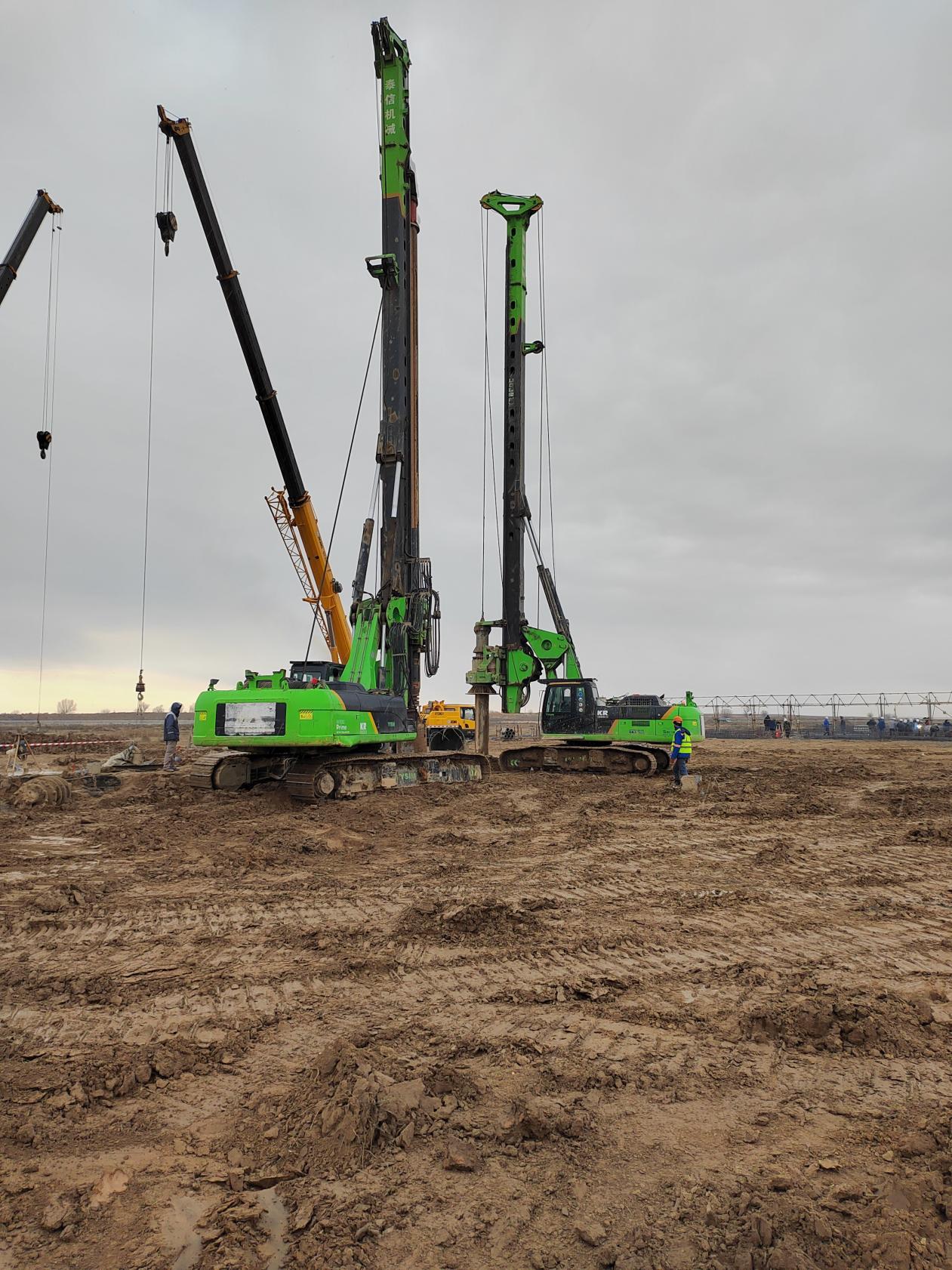
Cast-in-place pile foundation construction process: site cleaning→ Measure and set out to fix the pile position → Pile driver is in place → Pile drilling → Remove sediment at the bottom of the hole → Check the quality of the hole → Hoist the reinforcement cage → Pour concrete into the hole.
Precautions for construction of cast-in-place pile foundation: during drilling, the drill pipe shall be kept vertical and in correct position to prevent the hole diameter from expanding and the empty soil at the bottom of the hole caused by the shaking of the drill pipe. When the drill pipe is found to be shaken, moved, deviated or difficult to drill, the drilling rig should be hoisted for inspection, and underground obstacles should be removed to avoid pile hole deviation and drilling tool damage. During the drilling process, the clay at the orifice should be cleaned at any time. In case of groundwater, collapse hole, shrinkage hole and other abnormal conditions, the drilling shall be stopped and the relevant units shall be studied. When the drill bit enters the hard soil layer, it is easy to cause the drilling deviation. Can be up and down repeatedly sweep drill several times to remove hard soil. If the correction is not valid, the local borehole may be backfilled with clay to a point where the local borehole is greater0.5 m, and then re-drilling. After the drilling reaches the design depth, the drilling shall be protected and accepted according to the regulations, and the construction records shall be made.
The construction of cast-in-place pile foundation needs to clean up the empty soil at the bottom of the hole as much as possible. The empty soil at the bottom of the hole can be rammed with a rammer or treated with mud injection, then the steel cage can be hung quickly and concrete can be poured. Concrete shall be poured in layers, and the pouring height of each layer shall not be greater1.5m. In the soft plastic soil layer, when the water content is large, the fine-grained blade drill pipe is used to drill faster. Slowly and uniformly drill holes in plastic or hard plastic clay or sand with low water content. The drill pipe is required to be vertical during operation. If the drill pipe is found to be shaking or difficult to drill during the drilling process, it may encounter foreign matter such as rocks, and the inspection should be stopped immediately. The diameter of full blade spiral drilling is generally 300~600mm, and the hole depth is 8~20m. The drilling speed should be adjusted according to the current change. In the process of drilling, the accumulated soil at the orifice should be cleaned at any time, and the abnormal conditions such as hole collapse should be studied and solved in time.
Related News
2026-06-01
Address: No. 345 Yan Xin Road, Economic Development Zone, Wuxi City, Jiangsu Province
Sales Hotline:+8618112379331
E-mail:tyhen@tysim.com
Youtube
Tiktok
Copyright © 2024 Wuxi Tyhen Piling Equipment Rental Co., Ltd. Business License