
-
About UsWuxi Taiheng Foundation Engineering Co., Ltd. was established in February 2018. It is an eight-in-one specialized enterprise focusing on the sales of small and medium-sized piling machinery, equipment leasing, foundation construction, second-hand circulation, remanufacturing, accessories sales, operator training, construction method consultation and promotion.

News Center
Description of pile foundation construction process
Release time:
2022-11-15
Description of pile foundation construction process Pile foundation construction can be divided into precast piles and cast-in-place piles according to construction methods. Precast piles: Precast reinforced concrete piles are driven into the ground by a pile driver. The advantage is that it saves materials, has high strength, and is suitable for buildings with higher requirements, but the disadvantage is that the construction is difficult
Description of pile foundation construction process
Pile foundation construction can be divided into precast piles and cast-in-place piles according to construction methods. precast pile: Precast reinforced concrete piles are driven into the ground by a pile driver. The advantage is that it saves materials, has high strength, and is suitable for buildings with higher requirements. The disadvantage is that the construction is difficult and the construction time is long and limited by the number of machines. Cast-in-place pile: punch holes at the construction site first, and then put the steel bar into the poured concrete after reaching the required depth. The advantage is that the construction difficulty is low, especially the manual digging pile, which can not be restricted by the number of machines. All pile foundations are constructed at the same time, which greatly saves time. The disadvantage is that the bearing capacity is low and the material cost is high.
Construction process of pile foundation
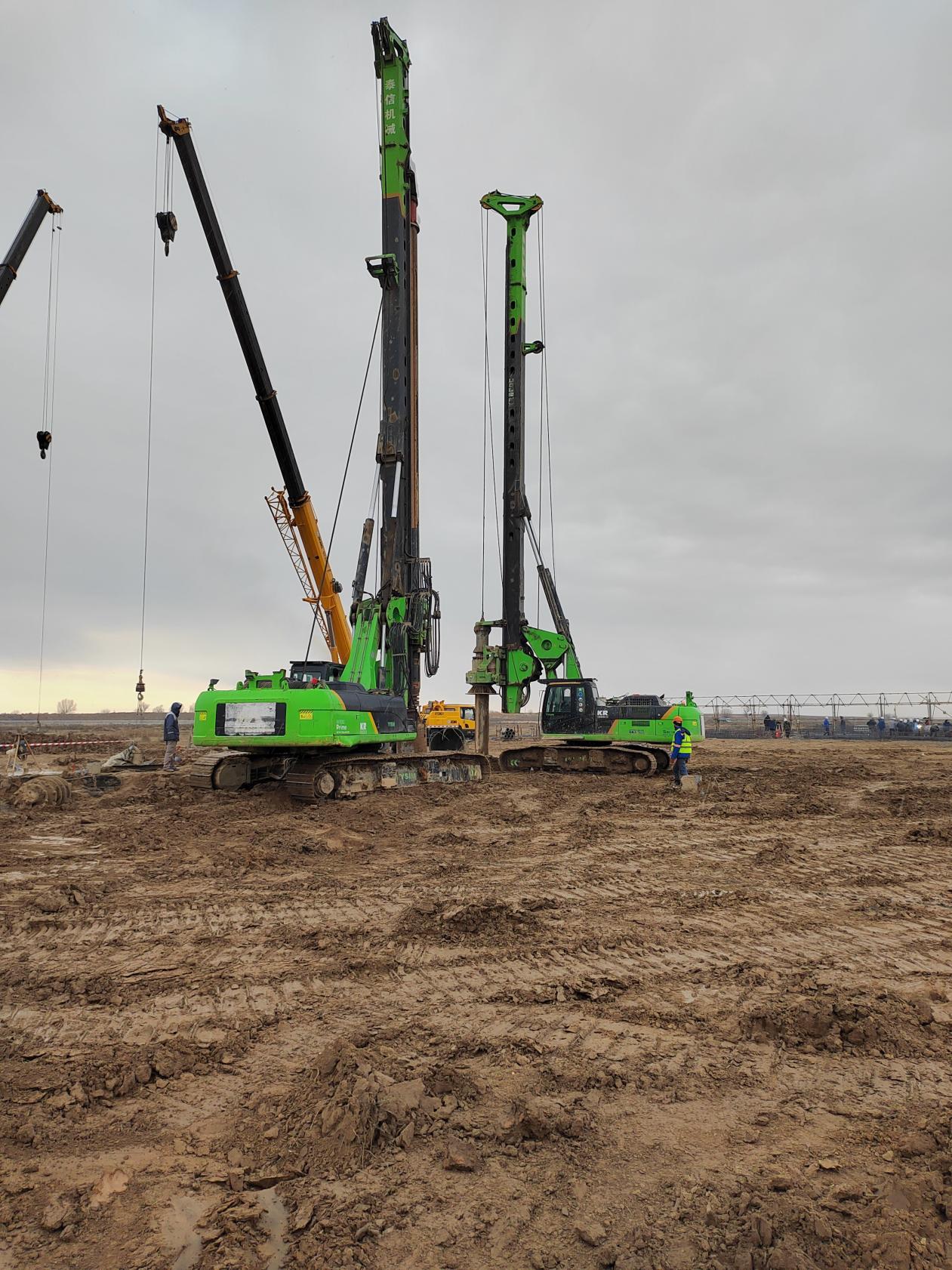
Determine the pile position.pile foundation constructionAfter the site leveling and cleaning is completed, the anchor point and leveling point of the pile foundation axis are set, and the position of each pile is determined according to the pile row construction drawing, and the mark is made. The pile position shall be checked and rechecked before construction to prevent deviation caused by external factors.
Buried protective cylinder. The role of the casing is to fix the position of the pile hole, prevent surface water from flowing in, protect the orifice, increase the water pressure in the pile hole, prevent the hole from collapsing, and guide the direction of the drill bit when drilling. CaveMade of 4-8mm thick steel plate, the inner diameter is 100-200mm larger than the diameter of the drill bit, the top surface is 0.4-0.6m higher than the ground, and 1 -2 mud overflow holes are opened on the upper part. When burying the pile casing, the topsoil at the pile hole shall be removed first, and the pile casing shall be buried in the soil. The buried depth of pile casing shall not be less than 1m for clay and 1.5m for sandy soil. The height shall meet the requirements of the slurry surface in the hole, and the slurry surface in the hole shall be kept at least 1m higher than the underground water level.pile foundation constructionWhen digging the buried pit, the diameter of the pit shall be 0.8~1.0 m larger than the outer diameter of the casing. The deviation between the center of pile casing and the center line of pile position shall not be greater than 50mm. After alignment, soil shall be filled on the outside of the casing and compacted in layers.
Mud preparation. Mud is used to protect the wall, carrying sand discharge, cutting soil lubrication, cooling drilling and so on. The slurry preparation method should be determined according to the soil conditionsWhen holes are formed in clay and silty clay, water can be injected into the original soil to make slurry, and the density of slag discharge slurry should be controlled at 1.1~1.3g/cm3; In other soil layers, the slurry can be made of high plastic clay or bentonite (Ip≥ 17). When drilling holes in sand layers and thick sand layers, the mud density should be controlled at 1.1-1.3g/cm3. When the borehole is formed by gravel layer or soil layer prone to collapse, the mud density should be controlled at 1.3~1.5g/cm3. During construction, the mud density, viscosity, sand content and colloid content shall be measured regularly. The control index of mud is viscosity 18~22s, sand content not more than 8%, colloid rate not less than 90%, in order to improve the quality of mud can add additives, such as weighting agent, viscosity, dispersant, etc. The waste mud and sludge during construction shall be treated according to relevant regulations of environmental protection.
Into the hole. Drill the drill bit to make a hole. Rotary drilling is one of the commonly used construction methods in the construction of bored piles in China. According to the different ways of slag, it can be divided into two kinds: positive circulation rotary drilling and reverse circulation rotary drilling.
Related News
2026-06-01
Address: No. 345 Yan Xin Road, Economic Development Zone, Wuxi City, Jiangsu Province
Sales Hotline:+8618112379331
E-mail:tyhen@tysim.com
Youtube
Tiktok
Copyright © 2024 Wuxi Tyhen Piling Equipment Rental Co., Ltd. Business License