-
About UsWuxi Taiheng Foundation Engineering Co., Ltd. was established in February 2018. It is an eight-in-one specialized enterprise focusing on the sales of small and medium-sized piling machinery, equipment leasing, foundation construction, second-hand circulation, remanufacturing, accessories sales, operator training, construction method consultation and promotion.

News Center
SR200R Rotary Drilling Rig Into Rock Test and Some Problems
Release time:
2021-07-28
From August 9, 2007 to September 7, 2007, Beijing Sany Heavy Machinery Co., Ltd. used the newly developed SR200R rotary drilling rig to carry out the rock entry test. The test site was "Yongfuqiang Quarry" in Zhoukoudian, Beijing. The rock entry geology was completely weathered to unweathered granite. On September 7, the test personnel drilled on site for dozens of visiting customers and experts from the piling association. They drilled 118mm of weakly weathered granite with Φ 1250 rock-socketed barrel for 4 minutes and 196mm of weakly weathered granite with Φ 1000 single-head single-screw drill for 2 minutes. On-site experts and customers are satisfied with the effect of entering the rock. See Table 1 "Field Test Record" for relevant test records ".
SR200R Rotary Drilling Rig Into Rock Test and Some Problems
From August 9, 2007 to September 7, 2007, Beijing Sany Heavy Machinery Co., Ltd. used the newly developed SR200R rotary drilling rig to carry out the rock entry test. The test site was "Yongfuqiang Quarry" in Zhoukoudian, Beijing. The rock entry geology was completely weathered to unweathered granite. On September 7, the test personnel drilled on site for dozens of visiting customers and experts from the piling association. They drilled 118mm of weakly weathered granite with Φ 1250 rock-socketed barrel for 4 minutes and 196mm of weakly weathered granite with Φ 1000 single-head single-screw drill for 2 minutes. On-site experts and customers are satisfied with the effect of entering the rock. See Table 1 "Field Test Record" for relevant test records ".
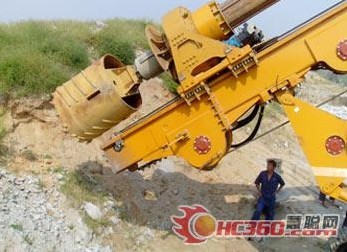
Geographical environment of rock entry test site
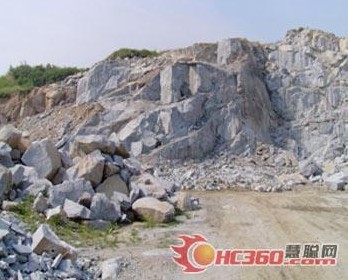
Geographical environment of rock entry test site
Test conclusion: It has been confirmed that the SR200R rotary drilling rig can drill in granite with Ra≤ 210MPa. It has been confirmed that the use of operating techniques can produce impact on hard rock, thereby improving the ability and efficiency of the drilling rig into the rock. It has been confirmed that by alternately using drill bits of different structures, free surfaces can be formed between more than two kinds of drill bits, which improves the drilling efficiency into rock. It has been confirmed that the vertical accuracy of drilling is 1/100.
Through the drilling test of limestone and granite with SR200R rotary drilling rig, the following six problems are realized and realized:
Basic conditions for main engine of 1. rock-entering rotary drilling rig:
The law of energy dissipation in rocks and the dynamic fracture criterion clearly state: "When the loading energy is less than a certain threshold value, the loading energy does not participate in crack propagation at all, and all is useless dissipation energy; when the loading energy reaches the dynamic fracture criterion, the rock is dynamically destroyed, and the reactive energy dissipation energy is about 15%." Taking this theory as a starting point, the rock rotary drilling rig must have a large pressure capacity and large power head power (large torque and high speed). First of all, under the action of high pressure, rock joints can be penetrated and cracks can be formed, and cohesion disappears, so that they can be separated from the rock mass only by overcoming friction. It can realize that small rock mass is squeezed to the free surface under pressure, cracks extend to the free surface, and small rock mass is sheared and separated from the rock mass. It can also realize that intact rock with RQD greater than 75 forms rock chips under rolling. Drilling can only be achieved if the complete rock is turned into fragments and debris. Secondly, the high torque and high speed hydraulic power head is a necessary condition to realize the impact operation. On the cutting track of the bit pick, the pick hits the raised rock mass, and the power head is decelerated. When the pick crosses the raised rock mass, the rotating speed accelerates and rushes to the new protruding rock mass, and the rock mass is continuously impacted during the conversion of high speed and low speed. The greater the speed difference between high speed and low speed, the greater the impact of the protruding rock mass. Only the hydraulic power head with large torque and high speed can increase the speed, for the rotary drilling rig (rock breaking machine with low power) entering the rock, the impact can effectively create some large loads to cross the "threshold value" of brittle fracture or plastic yield of the rock. The impact process must be realized for the rotary drilling rig to enter the rock. From the perspective of rock entry conditions, the anti-vibration capability of the equipment itself must be improved. The vibration sources in rock entry operation are the interaction between the drill bit and rock, the bending deformation of the drill pipe, the eccentricity of the drill bit, and the uneven distribution of the quality of the drill tool. The weight-on-bit is continuously cycled in the pressurization, decompression and floating modes. This cycle is controlled by the operator and its frequency is about 0.10~0.3Hz, which is also one of the vibration sources of rock drilling. Secondly, in the rock operation, one or several drill teeth constantly hit the raised rock to form an irregular "brake" phenomenon. The higher the rotation speed of the drilling tool, the more uneven the rock, the higher the frequency of "brake". This vibration sometimes has a high frequency, and the regularity of vibration excitation, superposition and failure is also very poor. From the above vibration sources, it is impossible to offset the damage to the equipment caused by forced vibration through active vibration, and the anti-vibration ability of the equipment itself must be improved.
From the "threshold value" of brittle fracture or plastic yield of rock crushing, it is required that sufficient force must be applied to the rock. This requires that the rock rotary drilling rig must have sufficient weight to achieve the large pressure capacity of the drilling rig.
In short, large pressure, power head power and drilling rig must have enough weight, is the rock into the rotary drilling rig equipment itself basic requirements.
2. rotary excavation energy into rock is achieved by impact:
From the rock drilling into the rock force on the way, all kinds of drilling rigs strive to achieve the impact of the rock, because the impact of the output of the equipment far beyond the static output. For example, the down-the-hole hammer is a direct impact on the rock through the impactor, reverse circulation drilling in the tooth wheel hob, wedge hob, etc. is through the hob on each point of the radius of rotation to achieve the impact of the rotation process on the rock.
Rotary drilling rig into the rock operation is achieved by controlling the weight on bit to achieve the impact on the rock. In the mode shown in Figure 2, the weight on bit continuously circulates three beats: floating, pressurization and decompression. When the pressure is increased, the rotation resistance of the drill bit increases and decelerates. When the pressure is reduced, the rotation resistance of the drill bit decreases and accelerates. From the momentum and impulse conversion equation (), it can be seen that the greater the speed change, the shorter the change time, the greater the impact on the rock. Through the impact, the problem of insufficient force of the drilling rig on the rock is effectively solved, and it is difficult to exceed the low load value of the broken rock. The formation of the free surface is also facilitated by the impact on the rock. During the continuous rotation of the drill bit, the cutter head intermittently impacts the rock, resulting in the continuous formation of irregularities in the direction of the tool, and the formation of new protrusions after the old protrusions are destroyed. These irregularities are the free surfaces of drilling, and both large and small free surfaces are conducive to the deformation of the rock under load (especially impact load) and the formation of debris from the whole rock mass, thus increasing the drilling efficiency. The large pressurization capacity of the drilling rig and the large power of the power head are the equipment conditions to realize the rock entry. The transformation of the equipment capacity into the effective rock breaking capacity must be reasonably matched by the pulse pressurization operation mode. From the "reasonable pressure mode of rock drilling" in Figure 2, the pressure mode of the rotary drilling rig into the rock is the combined action of dynamic and static loads, and the static load can improve the peak force of the impact dynamic load. Static load can also press the drill teeth on the rock at the bottom of the hole, so that the dynamic load is directly transmitted to the rock, reducing the power transmission loss and the power loss of elastic collision. The dynamic load is beneficial to make the load on the rock exceed a threshold value.
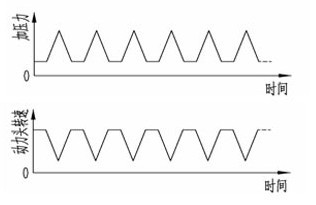
Reasonable pressure mode of rock drilling
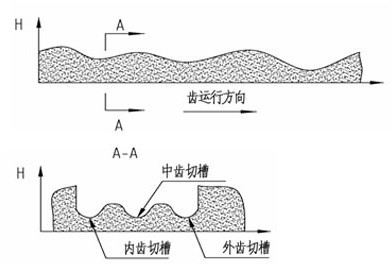
Cutting path formed by rock-socketed barrel drilling under rock-feeding pressure mode
The effective transmission of the rock-entering capacity and pressure mode of the 3. rotary drilling rig and the basic requirements that the drill pipe should meet:
When the rotary drilling rig is drilling into the rock, the torque and pressure of the equipment and the pressure mode on the rock are transmitted through the drill pipe, which plays a vital role in the transmission of the host capacity and the mode of action of the rock. In order to realize the impact on the rock, the operator must control the pressure device to pressurize, depressurize and float the drill pipe, so that the rock is impacted. If this pulsating pressure is absorbed by the elastic deformation of the structure during transmission, the rock cannot be effectively impacted. This test is a single drill pipe, which is conducive to the transmission of controllable WOB. Figure 2 shows a reasonable pressure mode of rock entry. The pressure may be attenuated through the transmission of multi-layer rods in the large and small cycles. The problem of multi-layer drill pipe transmission pressure mode needs to be considered. The smaller the number of drill pipe layers is, the more conducive to the formation of the impact of the drilling rig on the rock. Excessive drilling pressure at the peak point of pulse drilling pressure will cause local instability and deformation of the drill pipe or fatigue fracture due to repeated radial alternating load on a certain part of the drill pipe due to instability. Therefore, the drill pipe body should be thickened to enhance the radial deformation resistance, and the elasticity of the material should be increased to enhance the fatigue resistance under alternating loads.
The drill bit must be paid attention to during the 4. rock entry operation:
In the mechanical properties of rock, the compressive ability is strong, and the ability to resist stretching, shearing and bending is much worse, while the underground drilling equipment is difficult to directly stretch, shear and bend the rock directly due to the limitation of the working space. This requires the drill bit to convert the pressure and torque provided by the equipment into stretching, shearing, and bending of the rock. In order to make the drill bit effectively drill into the rock formation, the following five aspects should be solved. 1. Drill bit structure and tooth distribution: The drill bit structure and tooth distribution determine what shape of free surface, the size of free surface and the number of free surfaces can be drilled. As can be seen from Figure 4. 5. Figure 6 below, the early drilling of the bit provides a free surface for the later drilling,

Fig. 4. Free Surface Formed by Conical Spiral Bit Drilling
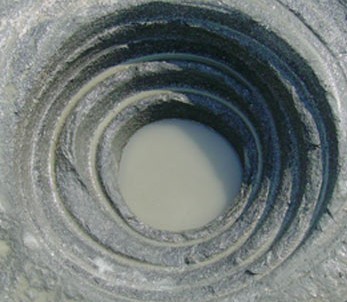
Fig. 5. Free Surface Formed by Conical Spiral Drilling
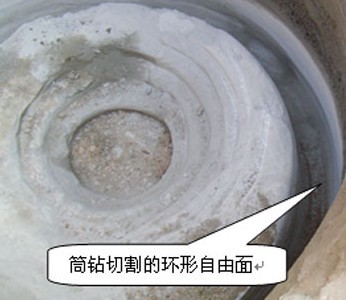
Fig. 6. Free Surface Formed by Alternate Operation of Conical Helical and Barrel Drilling
The drill bit drilled earlier creates the free surface of the rock mass fracture for the next drill bit. After the rock mass is stressed, the unrestrained free surface provides space for the operation of small rock blocks. From Figure 4, the pressure on the tool has been converted into shear force, tensile force or bending moment, and the rock mass is stripped from the large rock mass under the action of these forces. More than two kinds of drill bit alternate operation can provide each other with free surface (as shown in figure 6), so that the drilling efficiency is greatly improved, thus improving the rock breaking capacity and reducing the power demand of the host machine. For entering rock, different rock properties should be matched with drill bits in a targeted manner. The structure of the drill bit, the shape of the cutting tools on the drill bit (pick, bucket tooth, etc.) and the arrangement (density and spatial angle) should be set according to rock properties such as rock mass strength, joint development degree, joint inclination angle, void ratio, structural spacing, cohesion of rock mass shear strength and friction angle. Universal operation drill bits do not exist.
2. Movement of rock chips: rock chips hinder the drilling of drill bits in the hole, the resistance of rock chips is small, and the equipment capacity is used to do effective work. In the drilling, the screw conveying principle is generally used to convey and guide the movement and discharge of slag cuttings. Drill bits with smooth flow of slag chips are less labor-saving.

Fig. 7. Structure of Slag Cuttings Running on Rock Socketed Tube Drilling
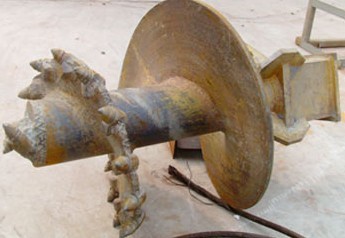
Fig. 8. Single Head Single Screw Cone Screw

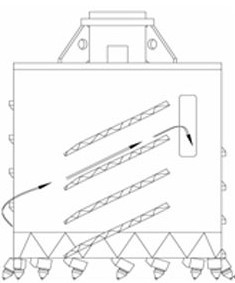
Fig. 10. Slag Chip Enters Drill Barrel from Gap of Spiral Slag Guide Strip
3. Failure modes of teeth: teeth are tools that directly act on rocks. There are roughly four main failure modes in use: first, the friction heat is too large, the contact surface between the teeth and the rock layer softens (or even melts) layer by layer, and the rock is squeezed and rubbed to flow; Second, the wear resistance is poor; Third, the number of drill teeth operating on a drill bit at the same time is small and overloaded. Fourth, the impact load breaks teeth. Other hard alloy is too soft, hard alloy and carcass welding unqualified. The cutting pick that fails due to overheating and softening belongs to the poor thermal strength of the carcass material. Large furrows appear on the carcass, indicating that the hardness of the carcass is much lower than that of the abrasive. The visible furrows appear in the hard alloy, which is too soft for the hard alloy. The reason for the fall-off of the hard alloy is poor brazing quality. A few teeth overload operations are irregular drill teeth. At present, the major reason for tooth failure is that the tooth quality is too poor. First, the pick produced by professional manufacturers has a low market share, and non-professional manufacturers basically do not know what performance teeth can meet the use requirements. Secondly, when users buy teeth, they are cheap and do not consider the cost performance.
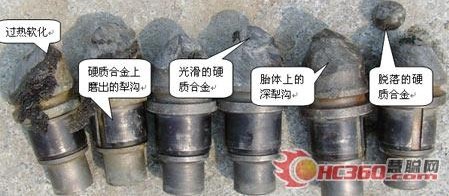
Figure 11. Failed pick
4. The cooperative use of several drill bits: The purpose of the cooperative use of several drill bits is to interactively provide a free surface conducive to rock crushing. After the rock is crushed, the broken rock is taken out. This involves two problems, the structural interaction of the drill bit to provide the possibility of a free surface conducive to rock fragmentation, and second, the mastery of the drilling depth of each drilling tool. The commonly used bit matching mode for drilling rock with rotary drill bit includes the mode suitable for hard rock (15 ≤Ra≤ 200MPa): the mode suitable for other tools (such as large block stone fishing bit) and soft rock (5 ≤Ra≤ 20MPa) of cone spiral drill bit for rock socketed tube drilling hard rock sand bucket: the mode suitable for flat head spiral drill hard rock sand bucket. There are also rotary drilling rig with reverse circulation method and rotary drilling rig with large diameter pneumatic down-the-hole hammer method, but these two methods can not reflect the advantages of rotary drilling rig, not much to explain here.
5. How to fish out large rocks: Using drill pipe with drill bit to directly fish out large rocks falling off the hole is an effective way to fish out large rocks in rotary excavation. The operator should be able to perceive that the large piece of rock has fallen off from the rock mass. After the large piece of rock has fallen off from the rock mass, it should be judged according to the characteristics of the rock whether it is broken and salvaged as a whole. There is a lack of tools on the market to salvage large pieces of rock from the hole as a whole. However, it is necessary to solve the problem of fishing for large rocks in deep holes. If large rocks cannot be fished out, drilling cannot continue.
5. must strive to reduce equipment damage and accidents caused by vibration:
The causes of equipment vibration are described in the "Basic Conditions for the Main Engine of Rock Rotary Drilling Rig", and the vibration hazards are as follows: ① The stress cycle of the equipment structure is accelerated under the action of vibration, and the structure has premature fatigue failure. ② Because of the uncertainty of the vibration direction, the load of the drilling rig structure is complex, and too much triaxial force is formed inside the structure, and the equipment is easily damaged. ③ Due to the excitation, superposition and failure of vibration, many structures have changed from static load to dynamic load, and most of them are impact load, which puts forward high requirements for equipment. ④ Accelerate the development and growth of tissue defects, such as welding micro-cracks and heat-affected zone hardening zone softening zone of the transition layer, the internal defects of the material, heat treatment micro-defects, etc. will absorb energy from the vibration to get development and growth.
In order to reduce equipment damage and accidents caused by vibration, the following points should be designed to grow suitable for rock rotary drilling rig: ① Calculate structural reliability from the perspective of dynamic load and fatigue. ② Strict selection of materials, selection of suitable processing technology and strict implementation. ③ Reduce the application of structures (such as screw connection) that are easy to fail in vibration.
The 6. puts forward some suggestions for the construction of rotary drilling rig into rock:
1. The effective service life of the tool is an important factor affecting the drilling efficiency and economy, and a qualified pick (or bucket tooth) must be selected.
2, to choose a kind of drill pipe and several kinds of drill bits with good engineering matching.
3. Different operation methods should be adopted for drilling into different lithology.
4. Control the depth of each drilling, master the method and timing of slag removal, and the cooling of the tool.
5. The drilling efficiency of the rock layer is 1/20~1/5 of the soil layer, and the loss of equipment and tools is much larger than that of the soil layer. It is necessary to choose a project with reasonable project cost.
Related News
2026-06-01
Address: No. 345 Yan Xin Road, Economic Development Zone, Wuxi City, Jiangsu Province
Sales Hotline:+8618112379331
E-mail:tyhen@tysim.com
Youtube
Tiktok
Copyright © 2024 Wuxi Tyhen Piling Equipment Rental Co., Ltd. Business License